
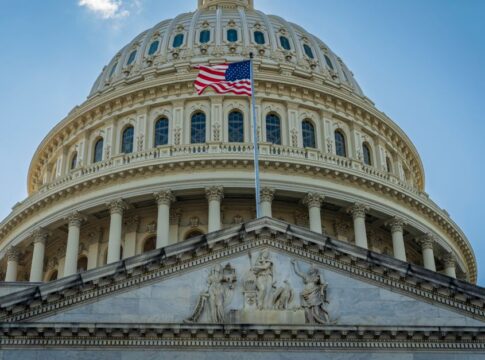
Photo: Mark Stebnicki / Pexels
By New Way News Newsroom, Politics Desk — Published November 19, 2026
Table of Contents
- Key Takeaways
- The Background & Context
- Why This Matters
- Reactions & Analysis
- What Happens Next
- Frequently Asked Questions
Two influential senators are sounding the alarm on Capitol Hill. They warn that artificial intelligence-powered cyberattacks now threaten America’s critical infrastructure—and that current defenses are falling dangerously behind. Senators Maria Cantwell and Mike Rounds have issued an urgent call for White House action, highlighting a vulnerability gap that could leave power grids, water systems, and communication networks exposed to sophisticated digital assaults. This bipartisan warning comes at a time when politics in Washington often seem gridlocked, yet the threat transcends party lines and demands immediate legislative and executive attention.
The senators warn White House officials that the pace of technological advancement in hostile hands is outstripping the government’s ability to protect essential services Americans depend on daily. While the exact details of their communication remain focused on policy channels, the message is clear: without swift, coordinated action, the nation risks catastrophic disruptions that could affect everything from banking systems to emergency services. The timing of this warning coincides with broader congressional scrutiny of how emerging technologies intersect with national security, making it a priority issue for both chambers as they consider future legislation.
This development underscores a growing recognition among lawmakers that cybersecurity can no longer be treated as a niche technical concern. It has become a central pillar of national defense, economic stability, and public safety—one that requires the full attention of the executive branch and Congress alike.
Key Takeaways
- Senators Maria Cantwell and Mike Rounds have warned the White House that AI-enabled cyber threats are advancing faster than U.S. defensive capabilities can counter them.
- The bipartisan appeal focuses specifically on protecting critical infrastructure, including energy grids, water systems, and telecommunications networks that millions of Americans rely upon.
- This warning arrives amid heightened congressional concern over the intersection of artificial intelligence, cybersecurity, and national security policy.
- Director of National Intelligence Jay Clayton has recently affirmed that widespread technology outages are not the result of coordinated attacks, providing some reassurance even as structural vulnerabilities persist.
- The senators’ call for urgent action suggests potential upcoming legislation or executive orders aimed at closing the cybersecurity gap.
- The issue transcends typical partisan divides, with both Republican and Democratic lawmakers recognizing the existential nature of the threat.
The Background & Context
America’s critical infrastructure has long been a target for foreign adversaries and criminal organizations. But the emergence of artificial intelligence as a weapon in the cyber arsenal has fundamentally changed the threat landscape. Traditional cyberattacks required significant human expertise and time to execute. AI changes that calculus entirely. Machine learning algorithms can now scan for vulnerabilities at superhuman speed, adapt to defensive measures in real time, and coordinate multi-vector attacks with a sophistication that once required teams of elite hackers.
Senator Maria Cantwell, a Democrat from Washington who chairs the Senate Commerce Committee, and Senator Mike Rounds, a Republican from South Dakota who serves on the Armed Services and Intelligence committees, bring complementary expertise to this warning. Their joint action reflects a rare moment of bipartisan consensus in an era when politics often fractures along party lines. Both senators have been vocal advocates for strengthening America’s technological competitiveness and national security posture, making them credible voices on this issue.
The critical infrastructure they reference encompasses sixteen sectors designated by the Department of Homeland Security as essential to national functioning. These include not just obvious targets like power plants and water treatment facilities, but also chemical manufacturing, transportation systems, financial services, and healthcare networks. A successful AI-enabled attack on any of these could cascade through the economy and society with devastating speed.
Meanwhile, Director of National Intelligence Jay Clayton recently addressed concerns about technology outages, clarifying that recent disruptions were not the result of coordinated attacks. This statement, while reassuring in the immediate term, does not diminish the senators’ broader warning about systemic vulnerabilities. If anything, it highlights the challenge: distinguishing between routine technical failures and deliberate attacks becomes harder as systems grow more complex and adversaries more sophisticated.
Why This Matters
For ordinary Americans, the implications are profound and personal. Consider what happens when the power grid fails. Hospitals lose backup systems. Food spoils in warehouses and homes. Water treatment plants shut down. Communication networks go dark. In winter, people freeze; in summer, they suffer heatstroke. These aren’t abstract scenarios—they’re documented consequences of infrastructure failures, whether caused by natural disasters or deliberate sabotage.
Now imagine those failures triggered not by a hurricane or earthquake, but by an adversary halfway around the world, using AI to exploit weaknesses in industrial control systems. The attack could be timed for maximum impact, coordinated across multiple sectors simultaneously, and designed to sow confusion about its source and nature. Traditional cybersecurity measures, built for yesterday’s threats, struggle against these adaptive, intelligent attacks.
The economic stakes are equally staggering. American businesses depend on reliable infrastructure to function. Supply chains, already stressed by recent global disruptions, could collapse if transportation and logistics networks face sustained cyber interference. Financial markets could experience volatility if trading systems or banking infrastructure come under attack. The ripple effects would touch every household, every community, and every sector of the economy.
From a political perspective, this issue forces Congress and the White House to confront difficult questions about resource allocation, regulatory authority, and the balance between security and privacy. Protecting critical infrastructure often requires increased government oversight of private companies that own and operate these systems. That tension between free enterprise and national security has long been a fault line in American politics, and it will only intensify as the threat grows more urgent.
Reactions & Analysis
The senators’ warning to the White House represents more than routine congressional oversight. It signals a belief that current efforts are insufficient and that executive action may be necessary to close the gap. While specific proposals have not been detailed in available reporting, the call for “urgent action” suggests potential pathways including executive orders, emergency funding allocations, or accelerated implementation of existing cybersecurity frameworks.
The bipartisan nature of this warning carries particular weight. In a Congress often paralyzed by partisan disagreement, issues that unite lawmakers from both parties tend to receive serious attention and resources. Rounds and Cantwell represent different ideological perspectives and different regional interests, yet they’ve found common ground on this threat assessment. That unity could translate into legislative momentum for cybersecurity bills that might otherwise languish in committee.
Intelligence officials, including Director Clayton, walk a delicate line in public statements about cyber threats. Revealing too much about vulnerabilities could provide a roadmap for adversaries. Saying too little leaves the public unprepared and policymakers under-informed. Clayton’s recent clarification about technology outages appears designed to prevent panic while maintaining vigilance—a balance that becomes harder to strike as threats proliferate.
Industry reactions will likely vary. Some companies that own critical infrastructure may welcome federal support and resources to upgrade defenses. Others may resist what they perceive as regulatory overreach or unfunded mandates. The technology sector, particularly AI developers, faces scrutiny about whether their innovations are being weaponized faster than safeguards can be implemented. These tensions will shape any policy response that emerges from the senators’ warning.
What Happens Next
The immediate question is how the White House will respond. Presidential administrations have several tools at their disposal, from issuing executive orders that mandate security standards for critical infrastructure operators to requesting emergency appropriations from Congress for cybersecurity initiatives. The National Security Council, working with agencies like the Department of Homeland Security and the Cybersecurity and Infrastructure Security Agency, would likely coordinate any comprehensive response.
Legislative action may follow. Congress could introduce bills that provide funding for AI-enabled defensive systems, establish new regulatory requirements for critical infrastructure protection, or create public-private partnerships to share threat intelligence. Given the bipartisan nature of the concern, such legislation might move faster than typical bills, though the details would still require negotiation between competing interests and priorities.
International cooperation will also factor into the equation. Cyber threats don’t respect borders, and AI-enabled attacks could originate from anywhere. The United States will need to work with allies to establish norms, share defensive technologies, and potentially coordinate responses to attacks. This diplomatic dimension adds complexity to an already challenging policy problem.
For the American public, increased awareness of these threats may lead to changes in how we think about digital security in daily life. Just as the post-9/11 era brought heightened security consciousness to physical spaces, the AI cyber threat era may bring similar awareness to digital infrastructure. That shift in public consciousness could support more aggressive policy measures that might otherwise face resistance.
Frequently Asked Questions
What makes AI-enabled cyber threats different from traditional cyberattacks?
AI-enabled threats can operate at machine speed, adapting to defenses in real time without human intervention. Traditional cyberattacks require hackers to manually probe systems, analyze results, and adjust tactics—a process that takes time and creates opportunities for detection. AI can automate this entire cycle, testing thousands of attack vectors simultaneously and learning from each attempt. This makes attacks faster, more sophisticated, and harder to defend against using conventional security measures.
Which critical infrastructure sectors are most at risk?
The Department of Homeland Security identifies sixteen critical infrastructure sectors, but energy grids, water systems, telecommunications networks, and financial services face particularly acute risks. These sectors increasingly rely on networked digital control systems that, while efficient, create potential entry points for attackers. Healthcare systems also represent high-value targets because disruptions can directly threaten lives, making organizations more likely to pay ransoms or comply with attacker demands.
Can individual Americans do anything to protect themselves from these threats?
While individuals cannot directly defend critical infrastructure, personal cybersecurity practices still matter. Strong, unique passwords, multi-factor authentication, regular software updates, and cautious behavior online reduce your vulnerability to attacks that might use your devices as entry points into larger networks. Additionally, having emergency preparedness plans—including backup power, water, and communication methods—can help families weather infrastructure disruptions regardless of their cause.
Is the United States falling behind other nations in cyber defense capabilities?
The senators’ warning suggests that adversaries are advancing their offensive AI capabilities faster than U.S. defensive measures can counter them. However, comparing national cyber capabilities is inherently difficult because much of this work occurs in classified settings. What’s clear is that multiple nations, including China, Russia, and North Korea, have invested heavily in cyber warfare capabilities, and the integration of AI into these programs represents a significant escalation that requires an equally serious response from American policymakers and security professionals.
As this story develops, Americans should watch for concrete policy proposals emerging from Congress and the White House. The senators’ warning has opened a critical conversation about how the nation prepares for threats that exist at the intersection of cutting-edge technology and age-old geopolitical competition. The decisions made in coming months could determine whether critical infrastructure remains resilient or becomes a vulnerability that adversaries can exploit with devastating consequences.