
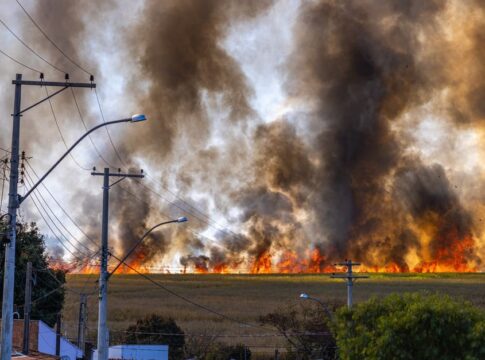
A rapidly expanding wildfire northwest of Reno, Nevada has forced 42,000 residents from their homes and injured six people as firefighters battle flames across 15,000 acres with zero percent containment, marking another destructive milestone in what has become the worst fire season in a decade.
Emergency Response Mobilizes Hundreds
The Hawk Fire ignited Saturday in the Peavine Peak area of Humboldt-Toiyabe National Forest, quickly spreading toward residential zones on Reno’s outskirts. Approximately 400 personnel supported by 10 aircraft from local, state, federal and international agencies have deployed to combat the blaze. Fire officials confirmed the incident was human-caused. Three civilians and three first responders sustained injuries as flames consumed an undetermined number of structures.
Evacuation orders reached the edge of the University of Nevada, Reno campus, while an additional 45,000 residents in surrounding areas received evacuation warnings. Washoe County authorities cautioned displaced families they may not return home for several days. Nearly all county schools closed Monday as multiple roadways shut down. Firefighters planned to use bulldozers creating fuel breaks on the southern and eastern perimeters, separating advancing flames from populated neighborhoods.
Historic Fire Season Devastates Nation
The Reno crisis unfolds during an exceptionally destructive year for American wildfires. Through August 23, the nation recorded 50,580 fires consuming 7,738,302 acres, dramatically exceeding 2025’s comparable period of 45,177 fires and 4,052,850 acres burned. The 2026 acreage surpasses every year from 2016 through 2025, eclipsing the previous high of approximately 6.62 million acres in 2017. The Northwest region experienced the heaviest activity, with 29 large fires requiring eleven complex incident management teams.
More than 22,000 personnel remained assigned to wildfire incidents nationwide Sunday, with 3.58 million acres attributed to large fires alone. The National Interagency Fire Center reported firefighters responded to 129 percent of the ten-year average number of fires, while burned acreage reached 169 percent of average levels. The escalating crisis strains resources across multiple states as communities face extended evacuation periods and property losses.
Protecting American Communities
The Hawk Fire demonstrates the ongoing threats facing Western communities during increasingly severe fire seasons. Firefighters engaged in point protection strategies prioritize saving homes and critical infrastructure as unpredictable conditions challenge containment efforts. Federal coordination with state and local agencies proves essential as resource demands exceed normal capacity. Families displaced from their properties face uncertain timelines for return while emergency personnel work to establish control lines and assess damage to neighborhoods caught in the fire’s path.