
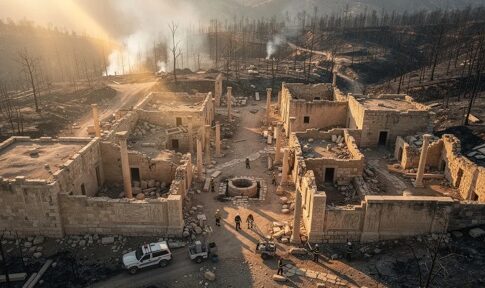
A wildfire in Israel’s Galilee region may have accomplished what decades of archaeological debate could not—revealing the long-sought biblical village of Bethsaida, where Jesus performed some of His most profound miracles and where three apostles called home.
Wildfire Unveils Ancient Mystery at Sea of Galilee
Wildfires swept through Israel’s Betiha Nature Reserve in late July 2025, burning away dense vegetation along the northern shore of the Sea of Galilee. What emerged from the charred landscape stunned archaeologists working at the el-Araj site. Dr. Mordechai Aviam of Kinneret College, leading the excavation team, discovered hundreds of meters dotted with earthen mounds, each potentially marking ancient rooms. The fire had inadvertently provided what systematic excavation alone could not—a comprehensive view of the ancient settlement’s layout beneath centuries of overgrowth.
Biblical Bethsaida and the Apostles’ Hometown
Bethsaida, meaning “house of fishing” in Hebrew, served as a first-century fishing village that the New Testament identifies as the hometown of three apostles—Peter, Andrew, and Philip. The Gospel of John explicitly names this village as their birthplace. Historical records indicate Herod Philip expanded the settlement into a larger town called Julias between 2 BCE and 39 CE. The site holds profound significance for Christians as the location where Jesus performed multiple miracles, including feeding the 5,000, walking on water, finding a coin in a fish’s mouth, and healing a blind man. These accounts anchor the village firmly in biblical history.
Decades of Archaeological Dispute Resolved
For nearly four decades, archaeologists argued over Bethsaida’s true location. Rami Arav excavated et-Tell from 1987 to 1997, claiming it as the biblical site despite its inland location and predominantly Iron Age artifacts. Doubts grew as researchers questioned how a fishing village could exist so far from water. El-Araj excavations beginning in 2016 yielded compelling evidence—first-century fishing gear, a Roman bathhouse, Jewish ritual vessels carved from limestone, and in 2022, an inscription referencing a “keeper of the keys” linked to Peter. The artifacts matched ancient descriptions from historians like Josephus far better than et-Tell’s findings.
Physical Evidence Supports Gospel Accounts
The el-Araj site sits directly on the Sea of Galilee’s shoreline, matching the New Testament’s description of a fishing community. Excavators uncovered implements used for commercial fishing operations consistent with Peter and Andrew’s occupation. A fifth-century Byzantine church built over the site commemorates what early Christians identified as Peter’s house, suggesting continuous recognition of the location’s significance. The discovery of Jewish ritual items, particularly limestone vessels used for ceremonial purity, confirms a Jewish population living according to first-century religious practices. This aligns precisely with the Gospel accounts of Jesus visiting a Jewish fishing village to call His first disciples.
Ongoing Excavations Target Roman Layer
Archaeologists now focus their ninth season of excavation on reaching the first-century Roman layer beneath Byzantine and Crusader remains. The wildfire-exposed mounds guide their trenching efforts, allowing teams to target specific areas with greater precision. Scott Stripling of Associates for Biblical Research co-directs the dig alongside Israeli scholars, representing a collaborative Christian-Jewish effort. While no definitive inscription naming Bethsaida has surfaced, the cumulative evidence—location, artifacts, historical texts, and Christian tradition—builds a compelling case. This discovery strengthens Israel’s connection to its biblical heritage and validates the historical reliability of New Testament geography, offering tangible confirmation of accounts many have cherished for two millennia.
Sources:
Wildfires Unveil Lost Biblical Bethsaida, Where Jesus Performed Miracles – Greek Reporter
Archaeology Breakthrough: Site of Jesus Miracles Found After 2000 Years – GB News
Long-Lost Site Where Jesus Performed Miracle Found After 2,000 Years – Unilad