
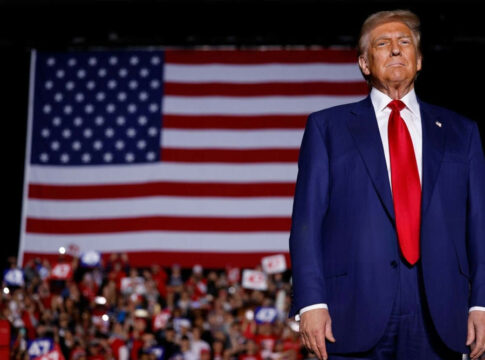
President Trump just declared himself the “Acting President of Venezuela” while simultaneously serving as President of the United States, marking an unprecedented assertion of American power in the Western Hemisphere.
A Bold Declaration of Dual Leadership
Trump stunned the political world by posting an official presidential portrait on Truth Social, accompanied by a title that would make the architects of the Monroe Doctrine proud. The image listed him as both “President of the United States” and “Acting President of Venezuela, Incumbent January 2026.” This wasn’t mere political theater—Trump meant business, announcing that America would “run Venezuela” until establishing what he called a “safe transition.”
The timing wasn’t coincidental. Just days earlier, US forces had conducted what Trump described as a “large-scale” military operation, capturing Maduro and his wife Cilia Flores from their fortress-like compound. The pair was swiftly transported to New York to face federal indictments on narco-terrorism charges—a dramatic end to years of Venezuelan socialist misrule.
Oil Revenue Control Becomes Central Focus
Trump’s plan extends far beyond symbolic leadership. He announced that Energy Secretary Chris Wright would oversee the transfer of Venezuelan oil operations, with 30 to 50 million barrels scheduled for sale. The proceeds wouldn’t disappear into government coffers—Trump pledged to manage them personally for the benefit of both Venezuelan recovery and American interests. This represents billions in potential revenue from what he called “high-quality sanctioned oil.”
American oil companies, previously deterred by Venezuela’s instability, now show eager interest. Trump boasted that these firms “wanna go in so bad” and promised “total safety” for investors willing to rebuild the country’s devastated energy infrastructure. The promise of security backed by American military might transforms Venezuela from an uninvestable pariah state into a potentially lucrative opportunity.
Contradictions Within the Administration
Trump’s declaration creates an awkward contradiction within his own administration. Secretary of State Marco Rubio had explicitly stated that the United States would not assume day-to-day governance of Venezuela, preferring to let Maduro’s former subordinates handle immediate administrative functions. Yet Trump’s Truth Social post and subsequent remarks on Air Force One suggest far more direct American control than Rubio envisioned.
Delcy Rodríguez, Venezuela’s vice president and oil minister, who was sworn in as interim president following Maduro’s capture, finds herself caught between competing narratives. While she publicly demands Maduro’s release and calls his capture “barbaric,” Trump claims she’s cooperating with American officials, saying, “We’ll do whatever you need.” This delicate balance reflects the complex realities of governing a nation under foreign oversight.
Monroe Doctrine Meets Modern Power Politics
Trump explicitly invoked the Monroe Doctrine to justify American intervention, reviving the 1823 policy that asserted US dominance throughout the Western Hemisphere. He framed the operation not as regime change or resource grabbing, but as a security imperative and humanitarian intervention. The president portrayed Venezuela as a “failed state” whose collapse threatened regional stability through drug trafficking and economic chaos.
The broader implications extend beyond Venezuela’s borders. Trump issued warnings to neighboring Colombia, calling it a “growing security concern” for enabling drug flows into America. His message was clear: unstable governments that threaten American interests should expect similar treatment. This represents a dramatic shift from diplomatic engagement toward direct action backed by military force.
Sources:
Trump describes himself as ‘Acting President of Venezuela’ in Truth Social post
Trump vows US in charge Venezuela he reveals hes spoken delcy rodriguez